Showing posts with label art. Show all posts

Tuesday, November 17, 2015

Vive La France

Je suis Paris.  Jean Julian here, the artist behind the Peace for Paris symbol.


Monday, January 6, 2014

marthe de florian

File:Boldini Marthe de Florian.jpgA 1940s Paris time capsule discovered in the apartment of one Madame de Florian, whose grandmother was the actress Marthe de Florian, and a muse of painter Giovanni Boldini (1884-1931), born in Italy, died in France, known as "Master of Swish."  One of his love letters to the actress (along with the painting shown left) was discovered in a Right Bank apartment the granddaughter fled during the second World War.  The apartment was never reentered until after her death in southern France in 2010.

Via Michelle Gable, Madame de Florian's grandmother was also a demimondaines, one of a group of very wealthy courtesans during the Parisian Gilded Age or Belle Époque (1871-1914) - known for drinking, gambling, drug use, and excessive spending on clothing.  They lived extravagant lifestyles provided by wealthy, well known lovers, one of whom, in this case, was the famous painter Giovanni Boldini, as well as the 72nd prime minister of France, George Clemenceau, a statesman known as "Père la Victoire" (Father Victory) or "Le Tigre" (The Tiger) who led France into the first World War and was one of the principal architects of the heavily punitive Treaty of Versailles.  When war first broke out, happy go lucky Parisians danced to initial news in the streets, unaware of the cataclysmic events also about to bring their Marthe de Florian Gilded Age to a grinding halt.  A George Clémenceau portrait was painted by Édouard Manet in 1879-1880, and Ferdinand Roybet painted a portrait of his wife, American born Mary (Plummer) Clémenceau .  The Clemenceaus had three children together, and although George had many lovers, including the captivating Marthe de Florian, when Mary Plummer decided to have her own affair with the children's tutor, he had her arrested, jailed for 2 weeks, stripped of her French nationality, and, then sent back to the U.S. on a third class steamer while taking custody of all the children.  On the other hand, another report has a separated (but never divorced) Mary Plummer becoming a magazine writer and tour guide, while raising a daughter Madeline who becomes a famous journalist, public speaker, and Red Cross nurse.  While Paris is under siege, Madeline's mother refuses Clémenceau's offer of evacuation and remains in France.

File:Mary Clémenceau, by Ferdinand Victor Léon Roybet.jpg


The first painting, shown above, of Madame de Florian's grandmother Marthe, discovered in this time  capsuled Parisian apartment in 2010, ultimately sold for €2.1 million.  The second painting, shown above, of Le Tigre's scarlet lettered Mary Plummer is reported by Wikipedia as unknown in its present whereabouts.

*Photo credit/top, via Wikipedia, Portrait of the actress Marthe de Florian aged 24 in 1898, by the artist Giovanni Boldini/second, via Wikipedia, portrait of Mary (Plummer) Clémenceau, by the artist Ferdinand Roybet - date of painting unreported, location of painting reported unknown.

Tuesday, December 17, 2013

kwakwah

http://gdb.voanews.com/EC0B174D-6461-4374-8936-EFAB406E7E1B_mw1024_n_s.jpg

The Los Angeles Annenberg foundation turns out to be one of the mysterious bidders in another controversial Paris auction of sacred Native American artifacts, this time selling off 24 antique masks from the Hopi and 3 from the San Carlos Apache tribes based in Arizona.  A French court ruled last December that an earlier contested auction could legally proceed, and in this case, the French court ruled similarly.

As reported at this blog, tribal members and supporters protested in France last April, since the masks - also known as Katsinam - are held by indigenous peoples to be real, sacred beings with a value that precludes sale as art. The Katsinam are also described as stolen during the early 20th century.

In a surprising twist of good news though, the kind that restores faith in humanity, it turns out that the charitable Annenberg organization intended all along to restore these pieces to the tribes in question - and had moved in on the auction with exactly that purpose.  A suspenseful short story, whereby secret French and English-speaking operatives, along with the tribes' attorney (via Survival International), collaboratively triumphed in the bidding war, ultimately making off with 21 Hopi artifacts and all three San Carlos Apache for 530,000 dollars.

In further good news, one of the three remaining artifacts was incidentally purchased by a private couple also intending to repatriate their acquisition to the Hopi.

The masks were made during the 19th and early 20th century.  Like many of the artifacts in dispute, they are used in religious ceremonies and eventually "retired or left to disintegrate naturally."  One Hopi protester said in April that children are not even supposed to look at them, and some websites report that display in photographs and media is offensive, though the images have been widely circulating throughout the internet.

Robert Redford leveraged his well-known voice in the protests, calling the auctions, "criminal."

From Huffpost:
The U.S. Embassy had also called for a delay so that tribal representatives could come to France to identify the artifacts and investigate whether they have a claim under the 1970 UNESCO Convention on the Export and Transfer of Ownership of Cultural Property, to which both France and the U.S. are signatories.
A widely noticed and magnificent Angwusnasomtaqa or Tumas Crow Mother, shown here in April's post, and variously reported as sold for 171,000 or 210,000 dollars, was among those acquired at the earlier auction in April when Reuters described another mysterious collector who suggested that he might one day "give some back."

Unfortunately, that was not an Annenberg operative.

As for this caper, if you will, Hopi katsina priest Sam Tenakhongva thanked Annenberg, attorney Pierre Servan-Schreibert, and Survival International, while asserting that no one should "have to buy back their sacred property."

“Hopefully," he said, "this gesture [of Annenberg's] is the beginning of a larger conversation to discuss and inform various communities about what is sacred and what is for sale.  Although we were disappointed in the decision of the court which allowed the sale to proceed, we will continue to work to protect our cultural heritage on behalf of our Hopi people and others."  He added, "Our hope is that this act sets an example for others that items of significant cultural and religious value can only be properly cared for by those vested with the proper knowledge and responsibility. They simply cannot be put up for sale."

Annenberg reports that the Native American Graves Protection and Repatriation Act gives federally recognized Native American tribes a way to reclaim "funerary objects from federal agencies and museums in the U.S.," but that the law does not apply to items held internationally.

The Navajo Observer reported on December 10th that 6 similarly contested items from the Zuni tribe in New Mexico were also up for sale at the December 9th and 11th Paris auctions at Eve Auction House.


*Photo credit/via Voice of America/Reuters,  Following a French court's ruling, Hopi and San Carlos Apache masks are displayed at an auction house in Paris, April 11, 2013.  Most will be returned to the groups following purchases by the Annenberg Foundation and a private couple. 

Sunday, December 15, 2013

in the studio


Eddie Martinez working on a painting in his Brooklyn studio, video below.  His 2010 mixed media on canvas The Feast (shown above) is currently on view at the Saatchi Gallery in London through March 2014, part of the exhibition, "Body Language."  Photo via New American Paintings in an Art Basel Miami Beach installation view.

Friday, November 8, 2013

le ballet mécanique

Le Ballet Mécanique (1924), a collaboration between American composer George Antheil, French painter, sculptor, and filmmaker Joseph Fernand Henri Léger, filmmaker Dudley Murphy, and American modernist artist Man Ray who contributed cinematographic input.


The Philadelphia Museum of Art is currently hosting an interdisciplinary exhibition through January 5th, 2014, Léger: Modern Art and the Metropolis.   Curated by Anna Vallye, the exhibit is designed to "shed new light on the vitally experimental decade of the 1920s in Paris when the great French modernist Fernand Léger (1881-1955) played a leading role in redefining the practice of painting by bringing it into active engagement with the urban environment and modern mass media. This will be the first exhibition to take as its inspiration and focus Léger’s monumental painting The City (1919), a cornerstone of the Philadelphia Museum of Art’s collection and a landmark in the history of modern art, placing it in dialogue with the urban art and culture of modernity."

PMA hosted a screening and discussion of Le Ballet Mécanique, what wiki describes as one of the masterpieces of early experimental filmmaking. Composer Antheil's "most enduring work" was intended as a soundtrack, but film and music were reportedly not brought together until the 1990s.

Wednesday, October 23, 2013

peace can be realized even without order

Teamlab installation shown in the video below at the Singapore Art Museum.


Seemingly endless holographic figures play music and dance, influenced by the sounds of the figures close to them.  From Teamlab's description:
[...] There is no lead figure that oversees or can influence all the other dancers, and there is also no center or order enforced on the crowd.  External events can cause disorder, but then in time gradually peace will be restored.
When a person enters the installation and a figure senses the viewer, the figure responds to that person and stops playing music.  The figure passes on this information to other figures close by.  After a short period of time the figure will start playing music and dance again, but this disturbance will have disrupted the harmony.  If, however, the viewer stays still or leaves, the dancers will begin to form back into one harmonious group and the feeling of peace will return.
More video of the work:


Here, too:


Teamlab describes the ancient Japanese Awa Dance Festival whereby various groups of dancers and musicians arbitrarily roam town playing and dancing as any given group so chooses.  As one group encounters another, each begins to "gradually and unconsciously" match the music and tempo of the other, "not due to any set of rules," and whereby, "an extraordinary peaceful feeling prevails,"  Teamlab stating:
Today, in the Internet age, the speed at which people can connect with other people has accelerated.  As a result people throughout the world have become increasingly connected, and the influence of connections to other people has become more important.  What we experience in this new age can be considered similar to the experience of the dance festival, and perhaps in these unordered connections there is a way to find peace.
And more - the concept of ultra subjective space.

Monday, September 30, 2013

Sunday, September 29, 2013

20,000 leagues under the sea

A photostream of the remarkable South Philly home of Adam Wallacavage, militant ornamentalist and father of octopus chandeliers.  Much of what you see in that photostream was made by Adam Wallacavage himself with a solo exhibition of his works, Magic Mountain, slated for the Jonathan LeVine Gallery in NYC, Oct 19th-Nov. 16th, 2013.  Mr. Wallacavage is also a photographer - so don't miss this series.  Or browse here at instagram.

Tuesday, September 10, 2013

from attic to museum

So journeys a newly discerned Vincent Van Gough, Sunset at Montmajour, enthusiastically unveiled by Amsterdam's Van Gough Museum on Monday.  Museum experts thought otherwise in 1991 when an undisclosed collector initially carried the painting over for them to have a look at.

Since 1991, new techniques for authenticating art have developed;  so, reports the New York Times, about ten years later, the owner (still haunted by questions, one gathers) took the painting back.  Enabled and emboldened by these new techniques, researchers looked again, and have been looking ever since, with Van Gough now believed to have indeed painted this "more experimental" work from his "mature period" on July 4th, 1888 when he wrote to his brother on the following day,
“Yesterday, at sunset, I was on a stony heath, where very small, twisted oaks grow, in the background a ruin on the hill, and wheat fields in the valley. It was romantic, it couldn’t be more so, à la Monticelli, the sun was pouring its very yellow rays over the bushes and the ground, absolutely a shower of gold. And all the lines were beautiful; the whole scene had charming nobility.”

http://cbsfwbam.files.wordpress.com/2013/09/sunset-at-montmajour-625.jpg?w=625&h=352&crop=1


 A flicker photographer (similarly bewitched, one supposes) snapped this yellow Montmajour sunset upon a group of wild horses.

The Museum of Fine Arts in Houston reports that painting on site in Montmajour was a constant struggle for Van Gough because of "fierce, blustering winds that swept through this region" and "whipped violently against his canvases."  MFAH is home to another 1888 Montmajour Van Gough titled The Rocks.  The Rocks played a key role in conclusively determining that Sunset at Montmajour was truly a Van Gough.

1888 is also the same year Van Gough's ear incident went viral

Via wiki, Montmajour Abbey, the "ruins" of which are said to be seen from a distance in Sunset at Montmajour.  During the Middle Ages, the abbey was an important pilgrimage site, and during the 18th century, housed a Maurist monastery that is now in ruins, shown second.  Wiki reports the building largely demolished for building materials after the French Revolution (1789-1799).

File:Montmajour-VueGénérale1.jpg

File:Montmajour StMaur 03.jpg
 
 
*Photo credit/top, New York Times, photographer: Herman Wouters; second, via cbswpam, Sunset at Montmajour, by Vincent Van Gough;  third, Wikipedia, uploaded by Len'Alex, March 2005, Vue générale de l'abbaye; fourth, Wikipedia, photographer: Marc Ryckaert (MJJR), Montmajour Abbey near Arles (département des Bouches-du-Rhône, France): ruins of the Monastère Saint-Maur, 18th century.

Sunday, August 25, 2013

in the studio

Via huffpost and Stucky Art, cartographer and artist Jerry Gretzinger has spent the last fifty years (and for the next twenty, plans to continue) sketching and painting a map for a fictional world.  An online version here.  I think it's called Ukrania, but I'm not sure.

Sunday, August 18, 2013

#daydetroit

Embedded image permalink
The internet rallies to save the Detroit Art Institute.  As I joined in the virtual "march" - which you can view on twitter at #DayDetroit (and better yet, also participate), I couldn't take my eyes off the museum's Paul McPharlin Puppetry Collection (example, photo left), "one of the most significant collections of historical puppets in the United States."

Check out more here, herehere, and here.

Ouch, the DIA also houses Howdy.

 What has become of us when our nation's most prized art collections are scattered to the winds?

Here are some of my picks from among the more traditionally smitten favorites;  a detail from Diego Rivera's Detroit IndustryBourguereau's hazelnut gatherersPaul Cézanne's bathers.


More news on this sad state of affairs from Rachel Maddow:

Visit NBCNews.com for breaking news, world news, and news about the economy

Wednesday, July 24, 2013

woodfish

In the studio and gallery with Bellingham, Washington artists Tom Wood and RR "Fishboy" Clark, from their February 2013 collaborative exhibit, Woodfish at the Lucia Douglas Gallery.  The youtube was made and posted by Bellingham artist and muralist Lanny Little.

Saturday, May 25, 2013

be nice or leave

A short documentary about "Dr. Bob" Schaffer, a New Orleans folk artist whose work is well known and displayed throughout the city.  Dr. Bob has been featured in many newspapers and magazines including the Smithsonian, the Times-Picayune, and Big City Rhythm and Blues-- and purchased by notables like Emmy Lou Harris and Mariah Carey.  Dr. Bob works in a 6,000 square foot Chartres Street warehouse often visited by other artists -- and where you can peruse a rich collection of signs, paintings, assemblages, found objects, and now charmed witticisms (like his familiar, "Be nice or leave.")

Wednesday, May 8, 2013

associations

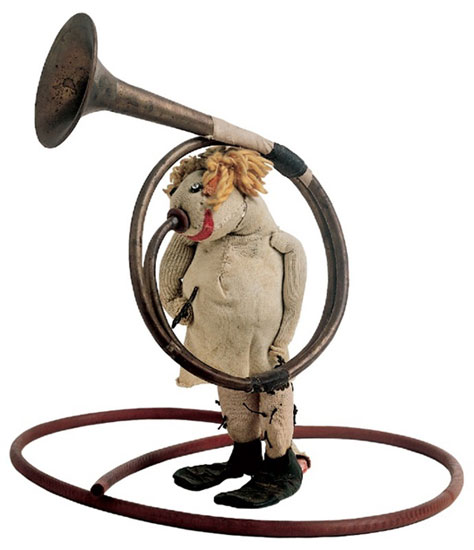
===blog==aug 19==klee puppet colorPaul Klee's puppets associated to Henry Darger.  In the early 1920's, he made 50 for his son Felix, 30 of which have survived.  Ptak also comments,
  
The puppets are intimate, made for his son for play, and are composed of bristle and bone and nutshells and electrical outlets and bits of gingham and cloth and wire and buttons.  Stuff from the junk drawn or whatnot box.  Klee did construct more elaborate puppets for his connection with the theatre, and of course was also a sculptor.  But I do like these little puppets, much in the same way as I enjoy the small toys made by Alexander Calder for his kids.

Charming Calder toy and circus photos here at Mochimochi Land who writes:  

calder3When living in Paris in the 1920s, Calder created a cast of human and animal figures made of wire and scraps of other simple materials. Each of these toys could perform a trick of motion when manipulated by hand: a lion tamer snapped a whip, a dog walked around on its hind legs. Calder held entire mini circus performances in which he would get down on the floor and manipulate his modernist toys for audiences adults and children. (Back in New York, fans could book Calder’s circus through the Junior League at Saks Fifth Avenue.)


Via Mochi, the Whitney has this youtube of Calder performing his circus, though noting that seeing it in person during the 1920's must have been a vastly different experience:


*Photo credit/top, Ptak Science Books/3 of Paul Klee's surviving puppets/second, Mochimochi Land, an Alexander Calder circus toy.

Monday, April 22, 2013

angwusnasomtaqa


A protested French auction of ancient and sacred Hopi masks went ahead in Paris via a judge's ruling.  It generated 1.2 million dollars in sales, the 1880's artifact shown above (World News/Art Et Communication / Ho / EPA), Angwusnasomtaqa or Tumas Crow Mother selling for the highest price at $210,000.  

During the auction of Crow Mother, a woman stood up amidst the group of about 200 applauding auction goers, calling out, "Don't purchase that.  It is a sacred being."   

Protesters gathered with signs outside the auction, urging auction goers not to participate.  Bo Lomahquahu, an American exchange student and member of the Hopi tribe said, "We have lots of art that can be shared with other cultures, but not these.  Children aren't even supposed to see them."

The buyer, who declined to be identified,  defended his purchase, stating that, ".. if it had not been for collectors in the 19th century who contributed to the field of ethnology, there would very little knowledge of the Hopi," and, "One day I might give some back."  The buyer acquired 3 other masks, expressing delight at being able to add to his collection of Hopi artifacts.

The Hopi tribe of northeastern Arizona and supporters, including the U.S. ambassador to France and actor Robert Redford, urged the Paris auction house to suspend the sale due to the masks' cultural and religious significance.  Robert Redford wrote:  "To auction these would be in my opinion a sacrilege, a criminal gesture that contains grave moral repercussions."

The French court rejected the motion from both the tribe and Survival International, a London-based advocacy group representing the tribe's interests, the court asserting that it could only intervene to protect human remains or living beings.

Pierre Servan-Schreiber, the lawyer for Survival International, said, "This decision is very disappointing.  Not everything is necessarily up for sale or purchase, and we need to be careful."

Thursday, April 18, 2013

the night watch

http://upload.wikimedia.org/wikipedia/commons/2/2f/Nachtwacht-in-3D.jpgVia MuseumResearch&Study, a Dutch flashmob adventurously arrives at the mall on horseback in a dramatic reconstruction of Rembrandt's most famous (and controversial) painting, The Night Watch (De Nachtwacht), or The Shooting Company of Frans Banning Cocq

Fascination around bringing the renowned work of art further "to life" is not new, including several films, music, possibly even the second movement of Gustav Mahler's 7th symphony.

Russian artist Alexander Taratynov created a bronze-cast representation of the painting - Nightwatch 3D - first exhibited in 2006, and now permanently installed in front of Louis Royer's 1852 cast iron statue of Rembrandt at the Rembrandtplein  in Amsterdam (shown in photo to the left, source: wikipedia, uploader: Hippolyte). Which the actors' rendition may show a more immediately apparent resemblance to.

According to wiki and Rembrandt The Nighwatch blogspot, The Night Watch is notable for its sense of motion - versus the more static military postures employed - along with the painting's large size and rendition of light and color.   The painting has had a long and colorful history of its own, including several alterations (also removing two characters), storage in a Dutch castle throughout World War II, theft, conspiracy theory, and two major acts of vandalism - one by a man throwing an acid, and another by an unemployed schoolteacher with a bread knife who later committed suicide.

http://upload.wikimedia.org/wikipedia/commons/8/84/Nachtwacht-kopie-van-voor-1712.jpg 


As for that surprising and enjoyable shoppers' *treat*, those actors (in seventeenth century outfits - and also swinging in from the ceiling) were promoting the re-opening of the Rijksmuseum in Amsterdam, and following an extensive restoration program since 2003.  The Night Watch is housed there - the Dutch national museum, that is, which is located in Museum Square, Amsterdam South, close to the Van Gogh Museum, the Stedelijk Museum Amsterdam, and the Concertgebouw.


*Photo credit, bottom/Wikipedia/public domain without source information/Recreation of Rembrandt's The Night Watch, the lines showing how the present painting was cut down from the artist's original.   You can see the two excluded characters to the viewer's left.